
What is Delhi Atal Canteen Scheme?
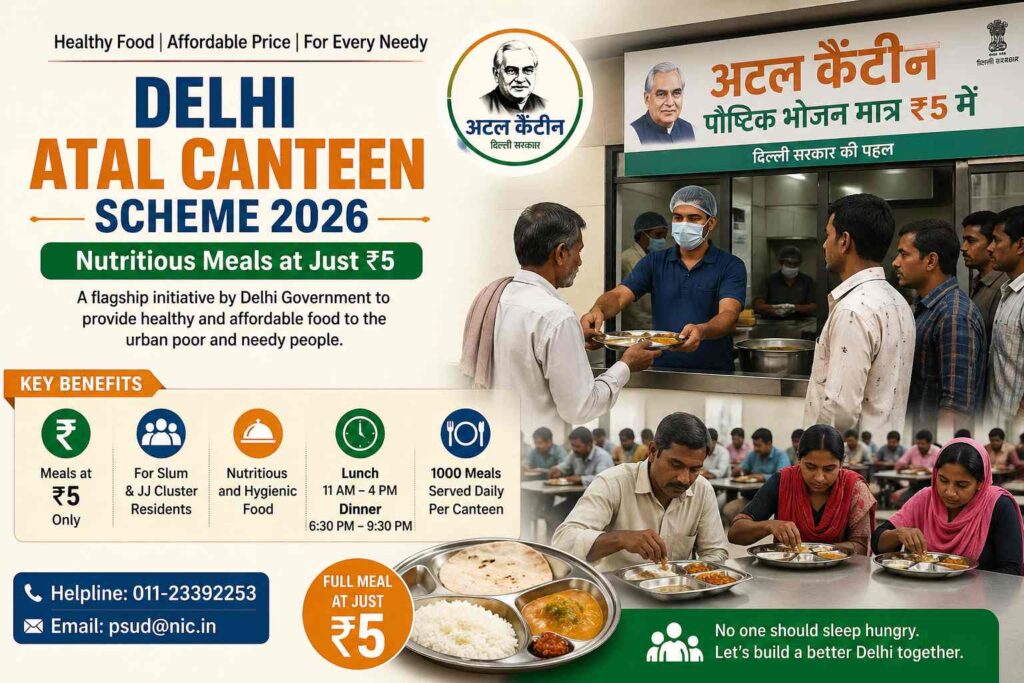
The Delhi Atal Canteen Scheme is a public welfare initiative designed to tackle one of the most pressing urban challenges — access to affordable food. Under this program, The Delhi Government provides nutritious meals at just ₹5, making it highly accessible for low-income groups.
Introduced on 25 December 2025, the scheme pays tribute to Atal Bihari Vajpayee and reflects his vision of inclusive growth and welfare.
Instead of complex registrations or paperwork, the scheme follows a direct access model, allowing anyone in need to walk into a canteen and eat.
Why This Scheme Matters
In a fast-growing urban city like Delhi, thousands of people depend on daily wages. For many families, even a basic meal can become a financial burden.
This scheme addresses that gap by:
- Reducing daily food expenses
- Providing consistent nutrition
- Supporting migrant workers and slum residents
- Preventing hunger in vulnerable communities
It’s not just a subsidy—it’s a dignity-driven food support system.
Quick Snapshot of the Scheme
| Category | Information |
| Scheme Launch | 25 December 2025 |
| Governing Body | Delhi Government |
| Meal Cost | ₹5 |
| Total Budget | ₹100 Crore |
| Planned Canteens | 100 |
| Currently Running | 45 |
| Beneficiaries | Urban poor, JJ clusters |
| Access Mode | Direct visit |
What Kind of Food is Served?
Meals under the scheme are kept simple, filling, and nutritious. The idea is not luxury, but reliable daily nutrition.
A Typical ₹5 Plate Includes:
- Freshly made chapatis
- Rice
- Seasonal vegetable curry
- Pickle for taste
Meals are cooked daily and served hot to ensure hygiene and quality.
⏱️ Serving Timings
Instead of operating all day, canteens function during two key meal windows:
| Session | Time |
| Midday Meal | 11:00 AM – 4:00 PM |
| Evening Meal | 6:30 PM – 9:30 PM |
Each canteen prepares around:
- 500 meals per session
- 1000 meals per day
Where Are These Canteens Located?
The government has strategically placed canteens in high-need areas rather than commercial zones.
Coverage Focus:
- JJ Clusters
- Slum settlements
- Industrial labour areas
- Resettlement colonies
Some Active Locations Include:
- Dwarka Sector areas
- Mangolpuri clusters
- Kalkaji flats
- Jahangirpuri
- Sangam Vihar
- Shahdara region
- Narela zones
More locations are being added as the scheme expands.
Core Objectives Behind the Initiative
This scheme is not just about food—it’s part of a broader urban welfare strategy.
Key Goals:
- Eliminate urban hunger pockets
- Improve nutrition among poor families
- Offer financial relief to daily earners
- Build a sustainable low-cost food system
💡 Major Benefits of the Scheme
1. Ultra-Low Cost Meals
At ₹5, it is one of the most affordable government food programs in India.
2. Zero Documentation
No Aadhaar, no forms, no verification barriers.
3. Immediate Access
Walk in, pay, and eat — no waiting period.
4. Inclusive Design
Open to anyone who genuinely needs food support.
5. Health & Nutrition Support
Regular meals help maintain basic nutrition levels.
Who Can Use Atal Canteens?
Although designed for specific groups, the scheme remains open in spirit.
Priority Groups:
- Slum residents
- JJ cluster inhabitants
- Daily wage workers
- Migrant labourers
👉 However, any needy individual can access meals.
Do You Need Any Documents?
No.
That’s one of the strongest features of this scheme — complete simplicity.
There is:
- No ID requirement
- No eligibility proof
- No registration
How to Get Food Under This Scheme
The process is intentionally kept extremely simple:
- Visit the nearest canteen
- Go to the counter
- Pay ₹5
- Receive a token
- Collect your meal
That’s it. No digital barriers or bureaucracy.
Interested in Running an Atal Canteen?
The government also allows participation from:
- NGOs
- Private operators
- Social organisations
How It Works:
- Tenders are released by the Urban Development Department
- Applicants must meet infrastructure and quality standards
- Selection is done through official procurement process
Official Contact & Support
For any scheme-related queries or complaints:
| Type | Details |
| Department | Urban Development Department, Delhi |
| Phone | 011-23392253 |
| psud@nic.in |
Important Resources (Add to Website)
For better SEO and user navigation, include these sections with real links:
- Official Department Website
- Tender / e-Procurement Portal
- Scheme Updates Page
- Public Grievance Portal
Complaint & Feedback System
To ensure accountability, the government has implemented a basic grievance system:
- Feedback registers at canteens
- Complaint submission via phone/email
- Monitoring of hygiene and food quality
Users can report:
- Poor service
- Food quality issues
- Mismanagement
Budget & Execution Plan
The scheme operates with a budget of approximately ₹100 crore, ensuring:
- Infrastructure setup
- Food supply chain
- Staff operations
- Monitoring systems
Implementation Approach:
- Phase-wise rollout
- Focus on dense low-income zones
- Regular inspections
Latest Updates (2026)
- 45 canteens currently functional
- Expansion to 100 locations underway
- Strong response from beneficiaries
- Government reviewing service efficiency
How It Compares to Other State Food Schemes
| Scheme | Location | Price Range |
| Atal Canteen | Delhi | ₹5 |
| Amma Canteen | Tamil Nadu | ₹1–₹5 |
| Indira Canteen | Karnataka | ₹5–₹10 |
Delhi’s model focuses more on targeted urban poor clusters.
❓ Frequently Asked Questions
Is registration required?
No, direct access is allowed.
Can anyone eat here?
Yes, especially those in need.
What is the meal cost?
₹5 per plate.
How many meals are served daily?
Two sessions — lunch and dinner.
Is food quality maintained?
Yes, monitored by authorities.
📝 Final Thoughts
The Delhi Atal Canteen Scheme 2026 represents a practical and impactful step toward solving urban hunger challenges. Instead of complicated welfare systems, it focuses on direct, simple, and immediate support.
With expansion underway, this initiative has the potential to become a model urban food program for other states in India.
Pingback: Delhi Free Bus Scheme 2026: Saheli Pink Smart Card - Citizen's Benefit