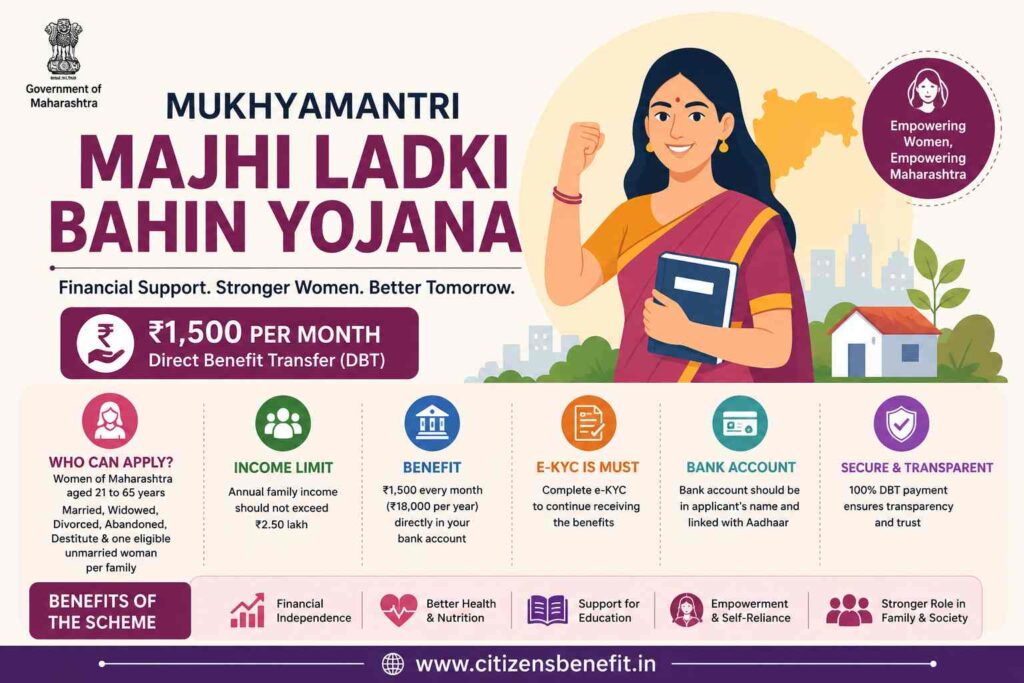
Mukhyamantri Majhi Ladki Bahin Yojana is a Maharashtra Government scheme designed to provide regular financial assistance to eligible women and support their economic independence. Under the scheme, eligible women receive ₹1,500 per month through Direct Benefit Transfer (DBT) into their bank accounts. The scheme is administered by the Women and Child Development Department, Government of Maharashtra.
The scheme was introduced in 2024, and its implementation has since included beneficiary verification and e-KYC. In 2026, the government completed a large-scale verification exercise to remove duplicate or ineligible beneficiaries and finalise the eligible beneficiary database. Reports in July 2026 stated that approximately 1.66 crore women remained eligible after verification, while around 66 lakh records were excluded.
If you are already receiving Ladki Bahin benefits, keeping your e-KYC, Aadhaar and bank details correctly updated is particularly important.
Mukhyamantri Majhi Ladki Bahin Yojana 2026 – Overview
| Particular | Details |
|---|---|
| Scheme Name | Mukhyamantri Majhi Ladki Bahin Yojana |
| State | Maharashtra |
| Implementing Department | Women and Child Development Department, Maharashtra |
| Main Objective | Financial support and economic empowerment of women |
| Monthly Assistance | ₹1,500 |
| Annual Assistance | ₹18,000 |
| Payment Method | Direct Benefit Transfer (DBT) |
| Eligible Age | 21 to 65 years |
| Family Income Limit | ₹2.50 lakh per year |
| Bank Account Requirement | Beneficiary’s bank account linked with Aadhaar |
| Eligible Women | Married, widowed, divorced, abandoned, destitute and eligible unmarried women as prescribed |
| Current Focus in 2026 | Beneficiary verification and e-KYC compliance |
The Maharashtra Government continues to list Mukhyamantri Majhi Ladki Bahin Yojana among its schemes under the Women and Child Development Department.
What Is Mukhyamantri Majhi Ladki Bahin Yojana?
Mukhyamantri Majhi Ladki Bahin Yojana is a Maharashtra Government welfare scheme introduced to strengthen the economic independence of women, improve their health and nutrition, and provide financial support to eligible women.
The original government resolution describes objectives including improving women’s financial independence, supporting their social and economic development, encouraging self-reliance and strengthening the welfare of women and dependent children.
Under the scheme, eligible beneficiaries receive ₹1,500 every month through DBT.
The money is intended to provide direct financial support to eligible women and can help with household expenses, personal needs, health, education, savings and other day-to-day requirements.
How Much Money Is Given Under Ladki Bahin Yojana?
Eligible women receive:
₹1,500 per month
This means the assistance can total:
₹18,000 in one year
| Period | Assistance |
|---|---|
| Monthly | ₹1,500 |
| 6 Months | ₹9,000 |
| 12 Months | ₹18,000 |
The amount is transferred directly to the beneficiary’s bank account through the prescribed DBT system.
It is important not to confuse the current monthly benefit with proposals or political announcements about increasing the amount. The amount currently supported by the government information available for the scheme is ₹1,500 per month.
Who Is Eligible for Majhi Ladki Bahin Yojana?
The scheme is intended for eligible women who satisfy the prescribed conditions.
The major eligibility requirements include:
1. Maharashtra residency
The applicant must be a resident of Maharashtra.
2. Age requirement
The woman must generally be at least 21 years old and not more than 65 years old.
3. Eligible marital or family status
The scheme covers eligible:
- Married women
- Widowed women
- Divorced women
- Abandoned women
- Destitute women
- One eligible unmarried woman per family
4. Family income
The family’s annual income must not exceed ₹2.50 lakh.
5. Bank account
The beneficiary should have a bank account in her own name that is appropriately linked with Aadhaar for DBT.
6. Other exclusion conditions
The family must also satisfy the government’s other conditions relating to income-tax status, government employment, certain political or government positions, vehicle ownership and other specified exclusions.
These conditions are important because satisfying the age and income requirements alone does not automatically guarantee eligibility.
Majhi Ladki Bahin Yojana Eligibility in Simple Terms
| Condition | Requirement |
|---|---|
| State | Maharashtra |
| Applicant | Eligible woman |
| Age | 21–65 years |
| Family Income | Maximum ₹2.50 lakh annually |
| Bank Account | Applicant’s account suitable for DBT and linked with Aadhaar |
| Married | Eligible |
| Widowed | Eligible |
| Divorced | Eligible |
| Abandoned | Eligible |
| Destitute | Eligible |
| Unmarried | One eligible unmarried woman per family |
Who Is Not Eligible for Ladki Bahin Yojana?
The scheme has several exclusion conditions.
A woman may not qualify where, for example:
- The family’s annual income exceeds ₹2.50 lakh.
- A family member is an income-tax payer.
- A family member is a regular/permanent government employee covered by the exclusion rules.
- A family member is receiving a government pension after retirement under the applicable exclusion conditions.
- The family has a four-wheeler registered in the name of a family member, except a tractor, where the prescribed exclusion applies.
- The family falls under other specified exclusion categories.
Certain categories of contractual, outsourced and voluntary workers may continue to qualify where they satisfy the prescribed conditions and income limit, so employment status should not be judged simply from the word “government” or “contract”.
What About Families With a Government Employee?
This is an area where applicants should be careful.
The eligibility rules exclude families having certain regular or permanent government employees and certain pensioners.
However, the rules do not treat every person working for or with a government-related organisation identically.
For example, the available scheme information specifically distinguishes certain outsourced, voluntary and contractual workers whose income remains within the prescribed limit.
Therefore, if someone in your family is a contractual or outsourced worker, do not automatically assume that the family is disqualified. The applicable government eligibility conditions should be checked against the individual’s exact employment status.
Documents Required for Majhi Ladki Bahin Yojana
The documents required can depend on the applicant’s circumstances.
The government scheme documentation includes documents such as:
- Aadhaar Card
- Maharashtra domicile certificate or accepted proof of Maharashtra residence/birth
- Income certificate where applicable
- Bank account/passbook details
- Ration card
- Beneficiary photograph
- Declaration or undertaking as required under the scheme
The original government documentation also provides alternative residence proofs in certain circumstances where a domicile certificate is not available.
Income proof
An income certificate may not be required in certain cases where an eligible ration card can establish the relevant income category.
For example, the scheme’s documentation provides different requirements depending on whether the family has a yellow/orange ration card or another category of ration card.
Therefore, applicants should not assume that every woman must obtain a fresh income certificate before proceeding.
Important Documents Checklist
Before applying or resolving a verification issue, keep the following ready:
| Document | Why It May Be Needed |
|---|---|
| Aadhaar Card | Identity and verification |
| Bank Passbook | Bank and DBT details |
| Maharashtra Residence/Domicile Proof | State residency |
| Ration Card | Family and income-related verification |
| Income Certificate | Income verification where applicable |
| Photograph | Application/beneficiary verification |
| Marriage Certificate | May be relevant for certain newly married applicants |
| Declaration/Undertaking | Confirmation of scheme conditions |
Majhi Ladki Bahin Yojana e-KYC 2026
e-KYC has become one of the most important parts of the scheme’s current implementation.
The Maharashtra Government carried out beneficiary verification to identify duplicate, incorrect or otherwise ineligible records.
In July 2026, reports stated that the verification and e-KYC exercise had been completed and approximately 1.66 crore beneficiaries were finalised, while around 66 lakh records were excluded during the verification process.
This means existing beneficiaries should not ignore e-KYC requirements.
If your record has a problem with e-KYC, the issue should be resolved through the prescribed process rather than assuming that payments will continue automatically.
What If There Was an Error During e-KYC?
Some beneficiaries experienced problems because an incorrect option was selected during the e-KYC process.
The Maharashtra Government subsequently made arrangements for physical verification in certain cases involving e-KYC errors, with local officials such as Anganwadi workers involved in the verification process.
If your e-KYC was completed incorrectly:
- Do not create another application unnecessarily.
- Check your existing beneficiary record.
- Contact the concerned local authority or designated official.
- Explain the e-KYC error.
- Complete the correction or physical verification process if instructed.
- Keep proof of your beneficiary details and previous application information.
How to Apply for Majhi Ladki Bahin Yojana?
The scheme originally provided online and assisted application mechanisms.
However, applicants should distinguish between the original application process and the current 2026 beneficiary-verification situation.
The scheme’s original process allowed women to submit applications through designated channels, including assisted government/local facilities and the Nari Shakti Doot application system. The supplied scheme material also describes application through Anganwadi-related offices, Gram Panchayat facilities and other designated centres.
For someone who has already applied, the important steps in 2026 are generally verification, e-KYC and ensuring that the beneficiary record and bank details remain correct.
For a person who has never applied, the availability of a fresh application window should be confirmed through the current government system before submitting any form.
Is Fresh Online Registration Open in 2026?
This is an important distinction.
The fact that the official portal exists does not mean that a fresh application window is continuously open.
The scheme was originally launched with an application process, but the current implementation has been heavily focused on verification, e-KYC and continuation of benefits for eligible beneficiaries.
Therefore, do not trust websites claiming that a new registration form is automatically open simply because they display an “Apply Online” button.
If the government opens a new application window, applicants should use the official scheme mechanism and follow the latest instructions.
Nari Shakti Doot App and Ladki Bahin Yojana
The original application process used the Nari Shakti Doot application.
The supplied material states that applicants could log into the application using their mobile number, complete their profile and select the Majhi Ladki Bahin scheme before entering their personal, address, Aadhaar and bank details.
The original process also required supporting documents and beneficiary verification.
Important 2026 note
Old instructions found online about downloading the Nari Shakti Doot app should not automatically be treated as confirmation that a new application window is currently open.
Current beneficiaries should focus on their existing beneficiary record, e-KYC and payment status.
How to Check Majhi Ladki Bahin Payment Status?
If you are an approved beneficiary and your monthly payment has not arrived, first check whether:
- Your beneficiary record is active.
- Your e-KYC is complete.
- Your Aadhaar information is correct.
- Your bank account is linked appropriately for DBT.
- Your name and personal details match the beneficiary record.
- There is no verification issue.
You should also check your bank statement or passbook rather than relying only on SMS notifications.
If the payment remains missing, contact the appropriate local authority or designated scheme support channel and ask them to verify your beneficiary record.
Why Has My ₹1,500 Payment Not Been Received?
There can be several reasons.
1. e-KYC issue
Your e-KYC may be incomplete or incorrectly recorded.
2. Beneficiary verification
Your record may be under verification.
3. Bank-account problem
The account may not be properly linked or may have another DBT-related issue.
4. Aadhaar mismatch
Differences between your Aadhaar information and beneficiary records can cause problems.
5. Eligibility review
Your family may have been selected for verification following the large-scale beneficiary review.
6. Payment processing
Even eligible beneficiaries can experience delays during payment processing.
The July 2026 verification exercise is particularly important because a large number of records were reviewed before the beneficiary database was finalised.
What Should I Do If My Payment Has Stopped?
Do not immediately submit a completely new application.
Instead:
- Check your existing beneficiary status.
- Verify your e-KYC status.
- Check your Aadhaar-linked bank account.
- Check your bank statement.
- Contact the relevant local official if your record shows an issue.
- Ask whether your beneficiary record has been marked inactive, rejected or under verification.
- Follow the correction process provided by the department.
This approach is safer than creating duplicate applications.
Majhi Ladki Bahin Beneficiary List 2026
The beneficiary database has undergone significant verification.
The government has been working to ensure that benefits reach eligible women rather than duplicate or ineligible records.
The July 2026 verification update indicated that approximately 1.66 crore beneficiaries were finalised following e-KYC and verification.
If you previously received money but your payment has stopped, the most useful question is not simply whether your name appears somewhere on an old list.
Instead, you should confirm the current status of your beneficiary record.
Can One Family Have More Than One Beneficiary?
The scheme has specific rules concerning unmarried women and family eligibility.
The prescribed eligibility allows only one unmarried woman per family under the applicable condition.
At the same time, eligible married, widowed, divorced, abandoned and destitute women can qualify according to the scheme rules.
Therefore, family composition matters when determining eligibility.
Can a Woman Receiving Another Government Scheme Benefit Also Get Ladki Bahin Money?
Not necessarily.
The exclusion conditions include situations where the beneficiary is already receiving ₹1,500 or more per month through another government financial scheme, subject to the applicable rules.
This is one reason why applicants should provide accurate information rather than assuming that every government benefit can be combined.
Four-Wheeler Ownership and Eligibility
Vehicle ownership is another important eligibility condition.
The rules contain an exclusion for families having a four-wheeler, while a tractor is excluded from this particular condition.
Therefore, families should consider the ownership of vehicles registered in the names of family members when checking eligibility.
What Is the Main Purpose of the Scheme?
The scheme is not simply intended to provide a monthly payment.
Its broader objectives include:
- Improving women’s financial independence
- Supporting economic self-reliance
- Improving health and nutrition
- Strengthening women’s role within the family
- Supporting women and dependent children
- Encouraging social and economic empowerment
These objectives are reflected in the original Maharashtra Government resolution establishing the scheme.
Majhi Ladki Bahin Yojana vs Ladli Behna Yojana
These schemes are sometimes confused because their names are similar.
Mukhyamantri Majhi Ladki Bahin Yojana belongs to Maharashtra.
It should not be confused with Ladli Behna schemes implemented in other states.
| Feature | Majhi Ladki Bahin |
|---|---|
| State | Maharashtra |
| Department | Women and Child Development Department |
| Monthly Assistance | ₹1,500 |
| Age | 21–65 years |
| Income Limit | ₹2.50 lakh |
| Payment | DBT |
Always check the state before following application or eligibility information because similar women-focused schemes have different rules.
Important Mistakes to Avoid
Do not create duplicate applications
If you already have a beneficiary record, first investigate its status.
Do not give incorrect information
Providing incorrect family, income, employment or vehicle information can create verification problems.
Do not ignore e-KYC
e-KYC has become an important part of beneficiary verification.
Do not rely on old application instructions
Some instructions available online relate to the original 2024 application process and may no longer describe the current process.
Do not pay unofficial agents
There is no legitimate reason to pay someone who promises guaranteed approval.
Do not believe every ₹2,100 update
The currently supported monthly benefit is ₹1,500. Claims that the payment has automatically increased should be verified against an official government announcement before being treated as fact.
Latest Majhi Ladki Bahin Yojana Update 2026
The biggest development in 2026 has been the government’s beneficiary verification and e-KYC exercise.
The verification was intended to identify duplicate and ineligible beneficiaries and establish a more accurate beneficiary database.
By July 2026, the government had reportedly finalised around 1.66 crore eligible women, with around 66 lakh records excluded following verification. The June 2026 instalment had also been reported as credited to eligible beneficiaries.
The Women and Child Development Department continues to list the scheme as an active Maharashtra Government scheme, with its website updated in February 2026.
For existing beneficiaries, e-KYC and accurate beneficiary information are now among the most important things to check if payments are delayed or stopped.
Quick Eligibility Check
You are more likely to meet the basic criteria if:
- You are a woman residing in Maharashtra.
- You are between 21 and 65 years old.
- Your family’s annual income is within ₹2.50 lakh.
- You fall under one of the eligible categories of women.
- You have an appropriate bank account in your own name.
- Your bank account is linked with Aadhaar for DBT.
- Your family does not fall under the specified exclusion conditions.
- Your beneficiary record has passed the required verification/e-KYC.
Meeting these conditions does not by itself guarantee payment because the final beneficiary decision depends on government verification.
Frequently Asked Questions
What is Majhi Ladki Bahin Yojana?
It is a Maharashtra Government scheme that provides financial assistance to eligible women to support their economic independence and welfare.
How much money is given every month?
Eligible beneficiaries receive ₹1,500 per month through DBT.
How much is that in a year?
At ₹1,500 per month, the annual assistance is ₹18,000.
What is the age limit?
The prescribed age range is 21 to 65 years.
What is the family income limit?
The annual family income should not exceed ₹2.50 lakh.
Can unmarried women apply?
Yes, but the applicable rule provides for one eligible unmarried woman per family.
Can married women receive the benefit?
Yes, married women are among the eligible categories, provided all other conditions are satisfied.
Can widows and divorced women apply?
Yes, eligible widowed and divorced women are covered under the scheme’s prescribed categories.
Is Aadhaar required?
Aadhaar is an important identity and verification document, and the beneficiary’s bank account needs to be appropriately linked with Aadhaar for DBT.
Is e-KYC mandatory?
e-KYC has become an important part of beneficiary verification and continuation of benefits. Beneficiaries should ensure that their e-KYC information is correctly completed.
What happens if I made a mistake during e-KYC?
Certain beneficiaries with e-KYC errors have been allowed to undergo physical verification through the prescribed local process.
Why has my ₹1,500 payment stopped?
Possible reasons include e-KYC problems, beneficiary verification, bank-account issues, Aadhaar mismatch or an eligibility review.
Can I submit a new application if my payment has stopped?
Do not automatically submit a duplicate application. First check the status of your existing beneficiary record and determine why the payment stopped.
Can a family with a four-wheeler get the scheme?
The scheme contains an exclusion relating to four-wheelers registered in the name of family members, with tractors excluded from that condition.
Can government employees’ families receive the benefit?
Certain regular/permanent government employees and government pensioners fall under the exclusion rules. Certain contractual, outsourced and voluntary workers may be treated differently if they satisfy the prescribed conditions.
Is the benefit ₹2,100 per month in 2026?
The currently supported benefit is ₹1,500 per month. Do not treat unverified claims of an automatic increase to ₹2,100 as confirmed.
Is the Ladki Bahin application currently open?
The existence of the official portal does not mean that fresh registration is continuously open. Applicants should check the current government instructions before attempting a new application.
Where can I resolve an e-KYC or payment problem?
Start with the designated local scheme authorities and the relevant Women and Child Development/field-level officials. For e-KYC errors, the government has also used physical verification mechanisms in certain cases.
Conclusion
The Mukhyamantri Majhi Ladki Bahin Yojana 2026 continues to provide ₹1,500 per month to eligible women in Maharashtra through DBT. The basic eligibility framework includes Maharashtra residency, an age of 21–65 years, annual family income of up to ₹2.50 lakh, an appropriate Aadhaar-linked bank account and compliance with the scheme’s exclusion conditions.
For 2026, the most significant change is not a new payment amount but the large-scale verification and e-KYC exercise carried out to clean up the beneficiary database. Around 1.66 crore women were reported as final eligible beneficiaries after verification, while a substantial number of records were removed.
Therefore, if you are already a beneficiary and your payment is delayed, the first things to check are your e-KYC status, Aadhaar details, bank account and current beneficiary status.
If you are trying to apply for the first time, do not rely on old 2024 instructions or third-party websites claiming that registration is automatically open. The current application availability should be confirmed through the government’s active process.